This post contains affiliate links. If you purchase through my links, I may earn a small commission at no extra cost to you. Thank you for supporting Room Revival Studio!
You scroll through home decor accounts and wonder how their coffee tables look like a layout from a design magazine while yours looks like a pile. There is a remote, a stack of mail, a candle with a dusty lid, and two things you were going to put away three weeks ago. The difference between that magazine table and yours is not the table. It is not even the budget. It is knowing a few specific rules that professional stylists apply every single time they sit down to dress a surface.
These 15 coffee table decor ideas are the ones that actually work. Not vague advice about layering textures with no context. Real, specific moves you can make this weekend with what you already have or with a few smart additions. Pick three or four, apply them together, and your living room is going to feel like a completely different space.
1. Start With a Tray to Anchor the Whole Display
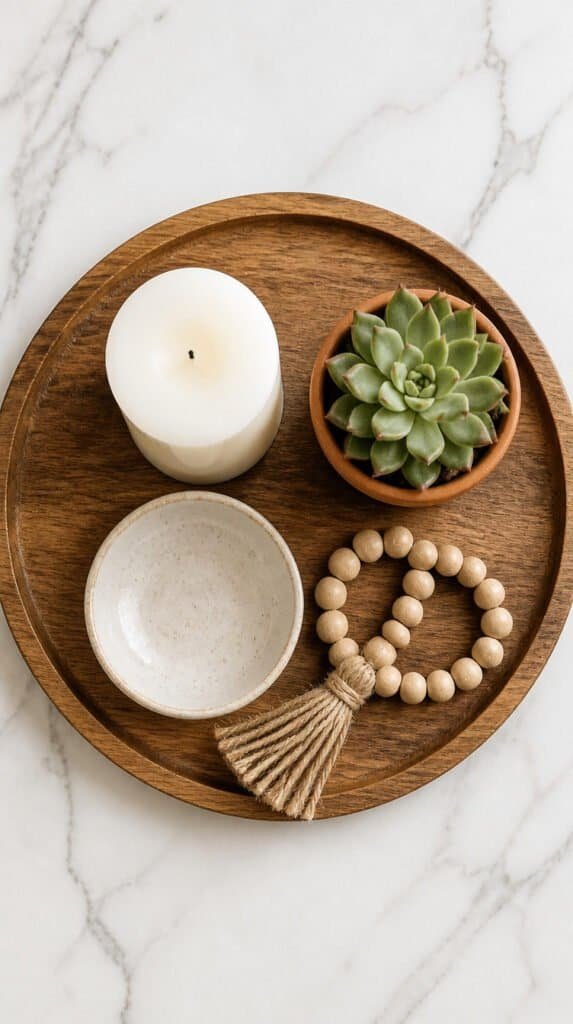
A tray is not just a decorative object. It is a frame. When you place a tray on your coffee table, you create a visual boundary that tells the eye where to start and where to stop. Everything inside the tray becomes an intentional arrangement. Everything outside becomes a counterpoint. Without a tray, even beautiful objects look scattered. With one, the same objects look curated.
The trick here: your tray should be large enough to hold three to five items with breathing room between them. A tray that is too small makes the whole display look cluttered even when there are only two things in it. Go larger than feels comfortable. Round trays read as soft and organic, which works beautifully in warm, minimal, and boho spaces. Rectangular trays read as structured and editorial, which suits modern and transitional rooms. Hot tip: do not buy a tray that matches your coffee table exactly. A contrast in material or tone makes the tray visible and intentional instead of invisible.
Wood, marble, lacquer, rattan, and woven seagrass all work depending on your room’s aesthetic. (The rule is always: if it would look good on a kitchen island, it will look good on a coffee table. Trays that serve in two contexts are worth buying.) Place your tray slightly off-center on the table, not perfectly centered. The slight asymmetry adds visual interest and makes the display feel organic rather than staged.
Shop the Look
- Round Wooden Decorative Tray Coffee Table
- Marble Serving Tray Rectangular Decor
- Woven Rattan Tray Decorative Large
- Lacquer Tray Coffee Table Styling
2. Add One Tall Element to Create Visual Height
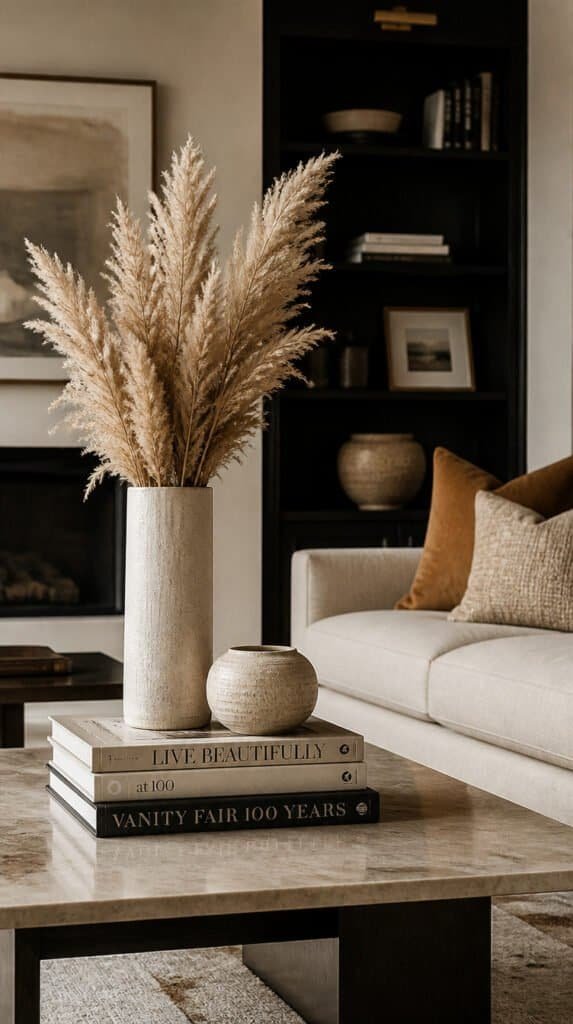
A flat coffee table display reads as one-dimensional no matter how beautiful the individual pieces are. The moment you introduce height, the display gains dimension, drama, and the kind of visual interest that makes people comment on a room. One tall element is all it takes to transform a flat arrangement into a layered one. And it does not need to be expensive or elaborate. A single stem in a slim vase, a tall pillar candle, or a sculptural object with vertical presence is enough.
The trick here: your tallest element should sit at the back or center of the tray, not at the front edge. Front-heavy displays look like they are about to fall off the table. Back-anchored height creates depth and draws the eye in and up. The ideal height for a coffee table display element is between twelve and eighteen inches. Taller than that and it starts to compete visually with the sofa. Hot tip: dried botanicals like pampas grass, bunny tail grass, or dried cotton stems give you height without requiring water or maintenance. They stay beautiful for months and fit almost every room aesthetic from cottagecore to modern organic.
A single stem in a slim bud vase, a tall sculptural ceramic vessel, a candle column in a hurricane holder, or a dried floral arrangement all work as height elements. (If your coffee table sits low to the ground, as many modern ones do, you may need your tall element to be closer to twenty-four inches to register from the sofa. Test by sitting down and looking at the table from where you actually sit.) The goal is to see height above the flat surface of the table from your normal seated position.
Shop the Look
- Dried Pampas Grass Stems Decor
- Slim Ceramic Bud Vase Tall
- Tall Pillar Candle Holder Glass
- Sculptural Ceramic Vase Tall Modern
3. Stack Coffee Table Books the Right Way
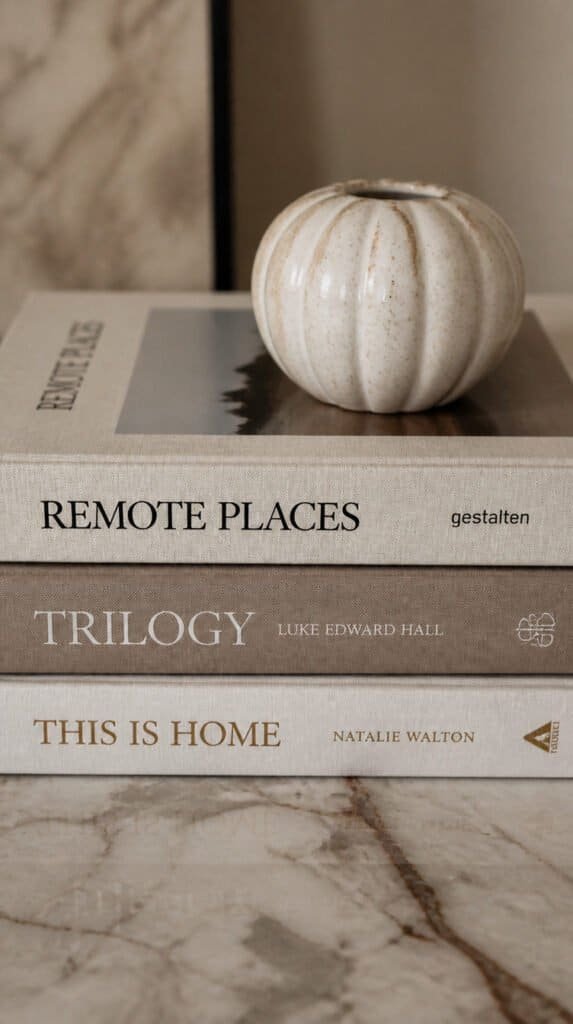
Coffee table books are doing two jobs at once: they add color, texture, and visual interest, and they function as a riser that lifts other objects off the flat surface. A stack of two or three books becomes a platform. Place a small decorative object on top of the stack and you have created a mini display within your display, with height variation built in. The books themselves also communicate personality in a way few other decor items can.
The trick here: always stack books horizontally, never standing upright. Standing books belong on shelves. Horizontal stacks are what you see in styled spaces because they create a stable platform, add visual weight at the table level, and make the spines readable at a glance. Limit your stack to three books maximum. More than three starts to look like you are storing them rather than displaying them. Hot tip: choose books with cover tones that work with your room palette. Cream, tan, sage, terracotta, and black covers work in almost every space. Avoid books with very loud, busy cover designs unless your room specifically has that energy.
If you have books you love but the covers are not working visually, remove the dust jackets. Many hardcovers underneath are a clean solid color that reads much better on a coffee table than a photographic dust jacket. (This is one of the most underused styling tricks and it costs nothing.) Place a small object on top of the stack to finish the vignette: a small figurine, a decorative stone, a small dish, or a single dried flower head all work beautifully.
Shop the Look
- Coffee Table Book Home Decor
- Coffee Table Book Architecture Design
- Small Decorative Object Coffee Table Top
- Book Stand Display Horizontal Riser
4. Choose One Sculptural Object That Earns a Second Look
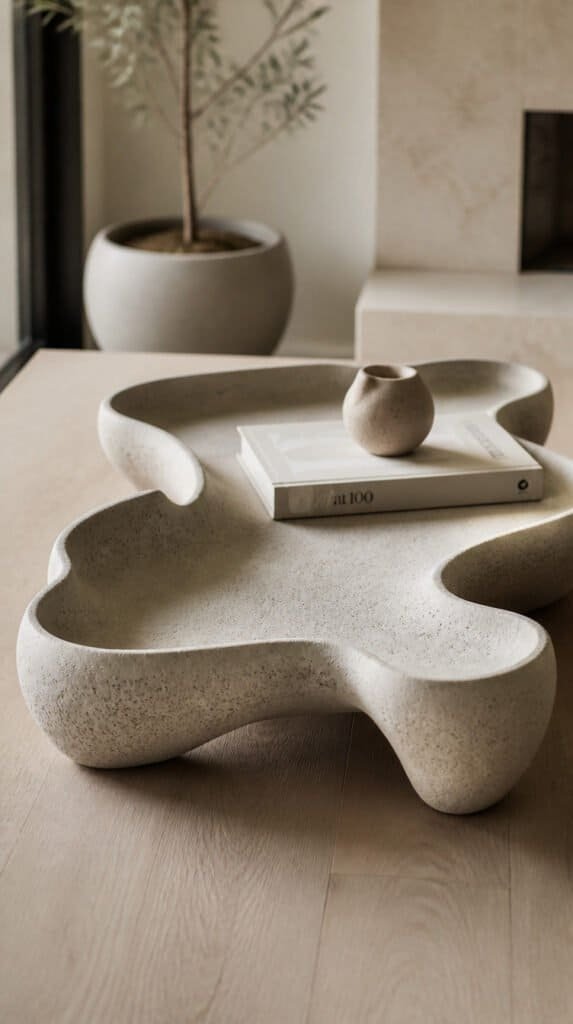
Every great coffee table display has at least one object that makes someone pick it up and look at it more closely. Not a candle, not a plant, not a book. A sculptural object with a shape or material that is interesting enough to examine. This piece is your conversation starter and your display’s personality. It communicates your taste in a way that carefully selected ordinary objects simply cannot.
The trick here: sculptural objects work best when they have an organic or unexpected form. Perfect spheres, abstracted human or animal forms, vessels with unusual profiles, or geometric objects in an unexpected material all qualify. The key word is unexpected: the object should make a person pause for a half-second and register it consciously. Hot tip: thrift stores and estate sales are the best places to find sculptural objects because unusual shapes often do not photograph well for resale, which means the good pieces sell in person for a fraction of what they would cost new. A one-of-a-kind ceramic piece from a thrift store will elevate a coffee table more than a new mass-produced object ever could.
Ceramic figurines, stone animals, carved wood objects, abstract resin pieces, selenite towers, or a single beautiful rock from a meaningful trip all function as sculptural display objects. (The only rule: it should have an interesting form in three dimensions. Objects that only read as interesting in photos but feel ordinary in person are not worth the table space.) Keep your sculptural piece as the only object of its type on the table. One unexpected thing is interesting. Two competing for attention are confusing.
Shop the Look
- Abstract Ceramic Sculpture Decor Modern
- Decorative Stone Sphere Marble Display
- Selenite Crystal Tower Home Decor
- Carved Wood Decorative Object Sculpture
5. Bring In Something Living or Organic
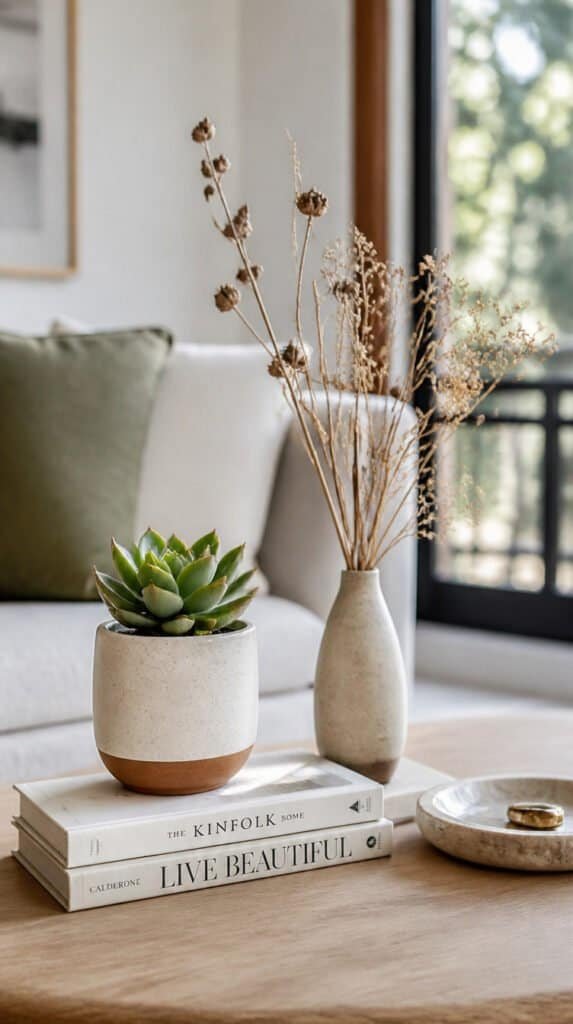
Every styled coffee table that feels genuinely alive has one thing in common: something organic. A plant, a fresh flower, a dried botanical, a branch, a piece of coral, a bowl of stones from a river. The organic element is what separates a display that feels warm and inhabited from one that feels like a hotel lobby. It introduces a kind of texture and irregularity that manufactured objects cannot replicate, and it connects the room to something natural and real.
The trick here: live plants are the gold standard but they require care. If you are not a plant person, dried botanicals last months and still bring the same organic quality. Dried cotton stems, bunny tail grass, eucalyptus, and lavender all hold their shape beautifully without water and add texture and color that complements almost every palette. Hot tip: a single small succulent in a terracotta pot is the most forgiving coffee table plant because it needs almost no attention. Water it once a month, keep it somewhere that gets ambient light from a window, and it will look perfect for years.
Fresh flowers in a small bud vase change the entire feel of a room and cost very little when you buy a single stem or a small bunch from the grocery store. Eucalyptus in a ceramic vase lasts weeks without water and smells incredible. A trailing ivy or pothos in a small pot adds movement and life at the table level. (Movement is one of the things that most indoor decor lacks. A trailing plant that reaches slightly past the table edge adds exactly that sense of life and flow.) Replace or refresh the organic element as needed to keep the display looking intentional.
Shop the Look
- Small Succulent Plant Pot Terracotta
- Dried Cotton Stems Decor Bundle
- Preserved Eucalyptus Stems Home Decor
- Small Ceramic Planter Indoor Plant
6. Keep a Catchall Bowl or Dish for Everyday Items
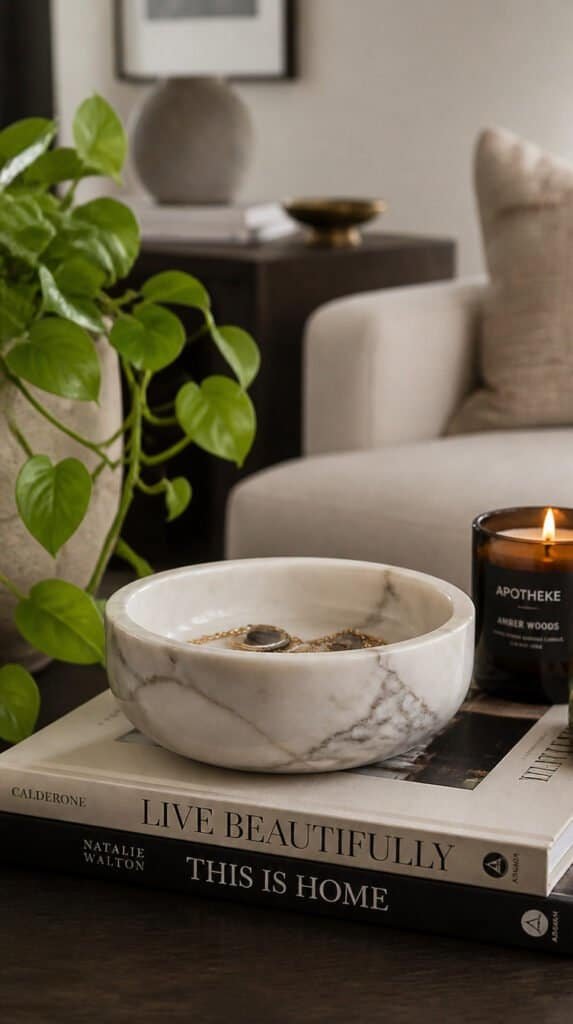
Here is the honest truth about coffee tables: things end up on them. Remotes, glasses, lip balm, a phone, a coaster, a pen. The question is not whether these things will appear on your table. The question is whether they have a designated home that keeps them from turning the whole surface into chaos. A beautiful catchall bowl or dish solves this problem permanently. Everything that lands on the table goes into the bowl. The surface stays styled.
The trick here: the bowl should be large enough to hold the items that realistically accumulate on your table but shallow enough that the inside is visible and looks intentional even when it contains functional items. A shallow ceramic dish or a small concrete bowl works better than a deep bowl where items disappear and it just looks like a junk pile. Hot tip: put your TV remote inside the bowl as part of the design rather than leaving it lying flat on the table. A remote inside a beautiful dish is a design choice. A remote lying on a table surface is clutter.
Marble trinket dishes, concrete bowls, ceramic ring dishes scaled up, shallow wooden bowls, and woven seagrass baskets all work as coffee table catchalls. (The material should feel like a deliberate design choice, not a container that migrated from somewhere else in the house. A plastic bowl, a mug, or a random container from the kitchen creates the opposite effect from what you want.) Choose one that feels like it belongs in the display and then commit to actually using it for its functional purpose.
Shop the Look
- Marble Trinket Dish Catchall Bowl
- Concrete Decorative Bowl Small
- Ceramic Shallow Bowl Decor Neutral
- Wooden Catchall Tray Small
7. Always Work in Odd Numbers
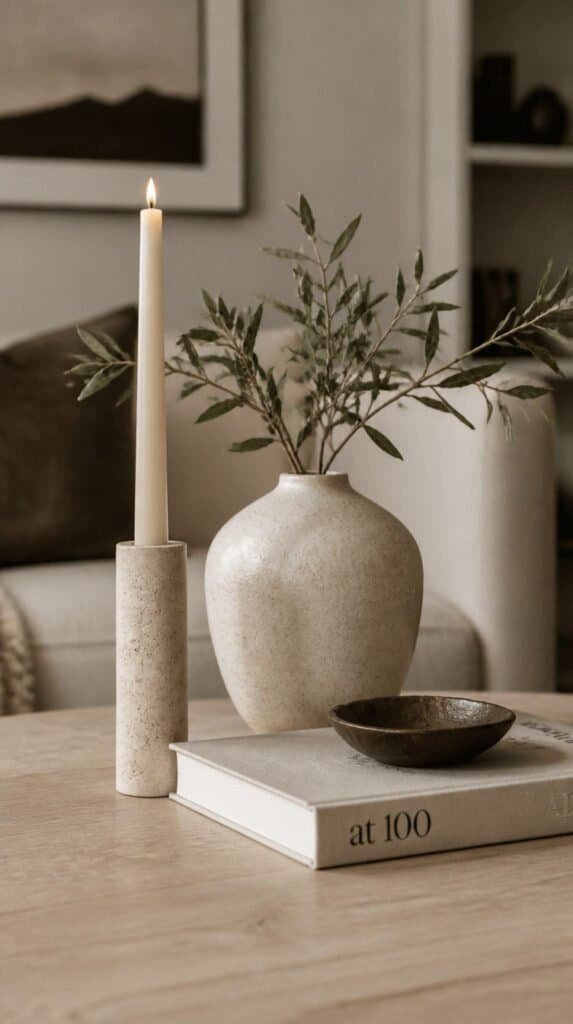
Interior designers and photographers have known this for decades: odd numbers are more visually compelling than even numbers. Two objects create symmetry and feel static. Three objects create movement and feel dynamic. A coffee table display built in groupings of three, five, or seven reads as intentional and interesting rather than paired and predictable. The eye moves differently across an odd-numbered grouping. It does not stop at one and look immediately to the other. It travels.
The trick here: within your tray, aim for three to five objects total. This is usually a tall element, a medium element, and a low element. A candle (tall), a bowl (medium), and a small figurine (low) is a perfect three-part composition. Add a book stack under one of them and you have five elements without the display feeling busy. Hot tip: if you currently have four items in your display and it feels off, try removing one. You will almost always land on a better composition. Even numbers on a coffee table almost always benefit from losing one piece.
This rule applies across the whole table, not just inside the tray. If you have a tray grouping plus a stack of books outside the tray, count them as a unit. If the total is an even number, consider combining or removing until you hit an odd count. (The rule is not magic. It works because odd numbers prevent the human eye from pairing objects automatically, which forces it to engage with the whole group as a composition rather than reading paired items and moving on.) Once you see it, you cannot unsee it.
Shop the Look
- Set of 3 Decorative Vases Neutral
- 3 Piece Candle Set Coffee Table
- Set of 3 Ceramic Bowls Nesting
- Decorative Object Set 3 Home Decor
8. Layer Three Different Textures

Texture is the secret ingredient in every display that feels rich without being expensive. When you look at a styled coffee table and it feels good but you cannot immediately articulate why, it is almost always because the textures are working together in an interesting way. A smooth ceramic next to a rough woven surface next to a soft velvet book cover creates a tactile conversation that your eye reads as sophisticated even when none of the individual pieces are particularly special.
The trick here: aim for three distinct textures in every coffee table arrangement. Smooth, rough, and soft is the classic combination. Ceramic (smooth), rattan coaster or woven basket (rough or woven), and a velvet-covered book or linen-wrapped object (soft) covers all three. You do not need to go searching for these. You likely already own them. Hot tip: coasters are an underrated texture opportunity. A set of rattan, stone, or cork coasters adds organic texture to the table while also being completely functional. Pull them out of the drawer and display them as part of the arrangement.
Other texture pairings that work beautifully: polished marble (smooth) with a dried grass bundle (rough) and a waffle-weave throw folded nearby (soft). Lacquered black tray (glossy smooth) with a concrete bowl (matte rough) and a linen-covered book (soft matte). Glass vase (reflective smooth) with a woven seagrass coaster (woven rough) and a cotton-wick pillar candle (waxy matte). (The textures do not need to contrast sharply. Even subtle variation between matte and glossy, rough and smooth, hard and soft creates the kind of layering that makes a space feel designed.) Choose textures you genuinely find interesting to touch, not just look at.
Shop the Look
- Rattan Coaster Set Natural
- Velvet Journal Coffee Table Decor
- Woven Seagrass Basket Small Decor
- Stone Coaster Set Marble Natural
9. Anchor the Center With a Round Object

Round objects at the center of a coffee table create visual stability in a way that angular objects rarely match. A round tray, a sphere, a circular candle, a round bowl, or a circular succulent pot at the center of your arrangement grounds the entire composition. The eye finds the circle first and then radiates outward across the rest of the display. This is why round trays are the most universally useful of all tray shapes and why round coffee tables are particularly easy to style.
The trick here: the round element does not have to be the only round object on the table, but it should be the largest or the most prominent. On a rectangular coffee table, place the round anchor element near the center of the tray. On a round coffee table, a circular tray in the center of the table mirrors the table shape and creates instant harmony. Hot tip: a large round candle placed in the center of a wooden tray is one of the simplest, most effective coffee table styling moves you can make. The candle provides the round anchor, the tray provides the frame, and the whole thing takes thirty seconds to assemble.
A large pillar candle, a round ceramic vase, a sphere made of stone or rattan, a circular succulent pot, or a round marble coaster used decoratively all function as center anchors. (Round objects also have a practical advantage on coffee tables: they have no sharp corners to catch a knee or a hip when you walk past the table in a narrow space.) On a table with sharp corners and hard edges, a round center element softens the whole composition and makes the room feel more relaxed.
Shop the Look
- Large Round Pillar Candle Decor
- Rattan Sphere Decorative Ball Display
- Marble Sphere Decorative Stone Ball
- Round Wooden Tray Large Decorative
10. Leave One Zone Intentionally Empty
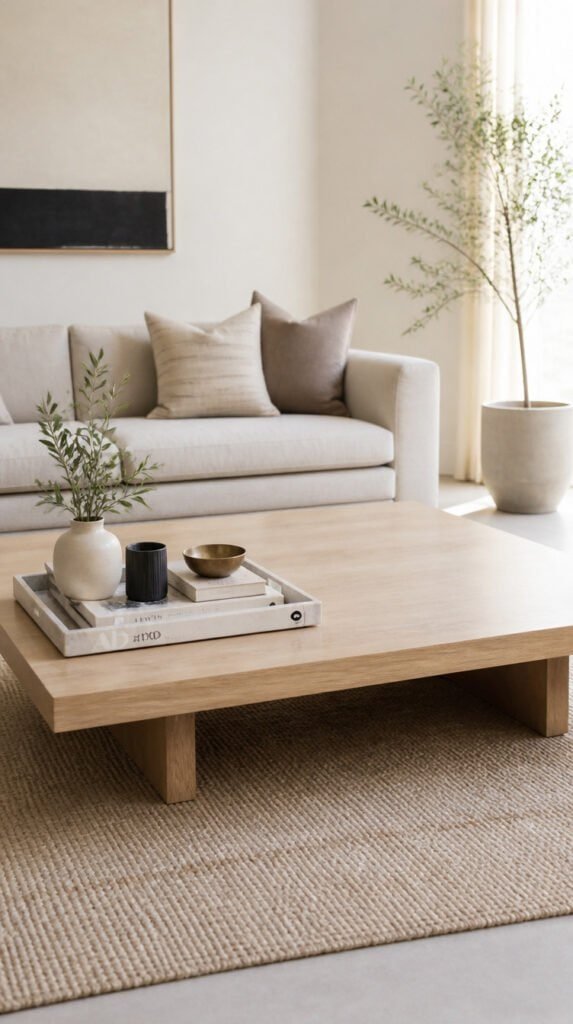
The impulse when styling a coffee table is to fill it. If there is empty space, something should go there. But professional stylists know the opposite is true: the empty areas are as important as the filled ones. Negative space gives the eye a place to rest between elements and makes everything in the display feel more intentional and more valuable. A coffee table with one styled zone and one deliberately empty zone looks curated. The same table completely covered in objects looks crowded.
The trick here: on a large rectangular coffee table, style one end with your tray and display grouping. Leave the other end completely clear or with a single object at most. The ratio should feel roughly sixty to forty or even seventy to thirty. Styled to empty. On a smaller round or square table, create breathing room around the tray by not extending objects past its edges. Hot tip: the empty zone is also practical. You need somewhere to set a drink, a book, a plate of food. A completely styled table with no functional surface space creates friction in daily life and leads to the display getting dismantled every time someone sits down.
If you cannot stop adding things, remove two items from your display. Look at what remains. Add one back if it feels incomplete. The edit is almost always the move that takes a coffee table from trying too hard to effortlessly styled. (The most common feedback people get when they share their styled coffee table is that it looks so clean. That feeling of cleanliness is entirely the result of negative space. The objects are not fewer. The space between them is greater.) Give your display room to breathe and it will reward you with a room that feels calmer and more polished.
Shop the Look
- Minimalist Coffee Table Decor Set
- Single Bud Vase Coffee Table Accent
- Decorative Coaster Single Marble
- Small Sculptural Object Neutral Decor
11. Match Your Tray and Objects to Your Room Palette
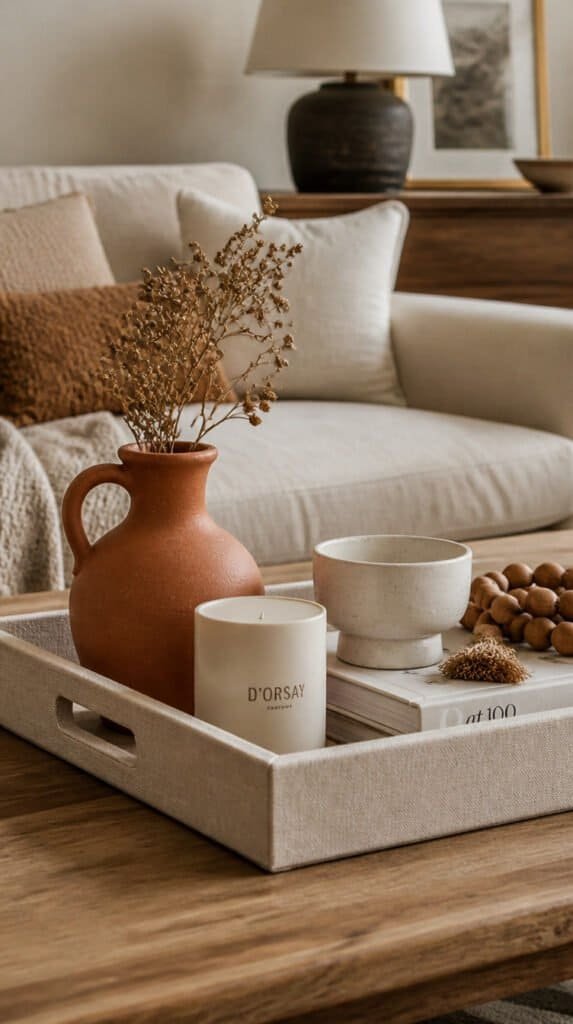
A coffee table that looks like it belongs in the room feels elevated. A coffee table that looks like it came from a different house feels off, even when the individual pieces are beautiful. Color is the thing that connects your display to the room around it. When your tray, your objects, and your books share tones that also appear in your throw pillows, your rug, your curtains, the whole room reads as a designed space rather than a collection of things that happened to end up together.
The trick here: pull two or three colors from your room and make sure they appear somewhere in your coffee table display. If your sofa is cream and your rug has terracotta tones, your tray should be cream or wood and your objects should include something terracotta. It does not need to be a perfect match. Close enough that the eye registers a connection is all you need. Hot tip: the fastest way to create color cohesion on a coffee table is to choose objects in your room’s neutral tones and then add one accent color that already appears elsewhere in the space. One terracotta vessel, one sage bowl, one black candle, one gold object. One intentional accent pulls everything together.
You do not need to repurchase your coffee table objects to achieve this. If your display feels disconnected from the room, try swapping one object for something in the room’s main accent color. A terracotta candle, a sage green book, a cream linen cover on a book that has a clashing dust jacket. (These small swaps cost nothing and sometimes make more difference than buying anything new.) Color is the most accessible styling tool you have because it requires only attention, not spending.
Shop the Look
- Terracotta Ceramic Vase Decor
- Sage Green Candle Decor Soy
- Cream Linen Journal Cover Book Blank
- Gold Decorative Object Coffee Table
12. Use Candles as Both Decor and Ambiance

Candles are doing double duty on a coffee table in a way that almost nothing else can. Unlit, they are sculptural objects with presence, color, texture, and varying heights. Lit, they transform the entire room. The warm light of a candle at table height creates an ambiance that overhead lighting cannot replicate. If you want your living room to feel welcoming, intimate, and genuinely comfortable, a candle on the coffee table is one of the highest-impact changes you can make.
The trick here: always group candles in odd numbers and at varying heights. Two matching pillar candles side by side is symmetrical and static. Three candles at different heights create movement and visual interest even before they are lit. Choose candles with a scent that complements your home’s existing scent profile, or stick to unscented if you have other candle or diffuser scents in the room. Hot tip: a candle that has been burned once reads as cared-for and lived-in, which is actually more appealing in a home setting than a brand new candle with a pristine untouched wick. Do not be precious about burning your coffee table candles. They look better for it and the scent is the whole point.
Pillar candles on a tray or in a hurricane glass, soy candles in ceramic vessels, beeswax tapers in a short candleholder cluster, and LED flameless candles for households with kids or pets all work beautifully. (LED candles have come a long way. The best ones flicker realistically and create the same warm light as real candles without any fire risk. For a coffee table in a busy household, they are often the more practical choice.) Whatever you choose, make sure the candle holder or vessel is beautiful in its own right, because it will be visible far more often than the candle is lit.
Shop the Look
- Pillar Candle Set Neutral Unscented
- Soy Candle Ceramic Vessel Home Decor
- Hurricane Candle Holder Glass Pillar
- Flameless LED Candle Realistic Flicker
13. Add One Personal Piece That Tells a Story

The difference between a room that feels like a home and a room that feels like a hotel is almost always the presence of personal objects. Hotel rooms are beautifully styled but they feel empty because nothing in them belongs to a specific person. Your coffee table has the opportunity to be the most personal surface in your living room. One object that has a story attached to it changes the feel of the entire display from generic to genuinely yours.
The trick here: personal objects work best when they are beautiful enough to be displayed even without their story. A rock from a beach in Portugal can be displayed on its own or alongside a small bud vase and it reads as a thoughtful design choice. A souvenir that only makes sense as a memento and has no visual interest on its own is better kept in a memory box than on a coffee table. The goal is one object that is both visually interesting and personally meaningful. Hot tip: a small framed photo in a beautiful frame counts. Choose a photo that means something and frame it simply. A personal photo in a well-chosen frame on a coffee table is one of the warmest, most human things you can include in a room.
A piece of pottery you made yourself, a crystal from a meaningful trip, a small figure that belonged to a family member, a book from someone you love, a pressed flower from a significant occasion. (The object does not have to announce itself or its meaning. It is enough that you know. Every time you sit on that sofa and see it, you feel the connection. That feeling is the whole point of decorating a home rather than just furnishing one.) Keep the personal piece small relative to the other display elements so it reads as a discovered detail rather than the dominant focus.
Shop the Look
- Small Picture Frame Gold 4×6
- Natural Crystal Specimen Display Decor
- Handmade Ceramic Small Vessel Decor
- Memory Keepsake Small Box Decorative
14. Scale Your Objects to Your Table Size

Scale mismatch is one of the most common reasons a coffee table display looks wrong even when all the individual pieces are attractive. A tiny tray on a large table looks lost. Large objects on a small table look crowded and clunky. The objects you choose need to be proportional to the surface they are sitting on, and the tray needs to fill roughly one-third to one-half of the table surface to anchor the display properly.
The trick here: if your coffee table is large (48 inches or longer), your tray should be at least sixteen to twenty inches in diameter or length. Objects inside the tray should be scaled up accordingly. A small bud vase on a large table disappears. A larger ceramic vessel reads properly. For small coffee tables (under thirty-six inches), a tray that is twelve to fourteen inches is proportionally appropriate and objects should stay small and tightly grouped. Hot tip: most people buy objects that are too small for their table. When in doubt, go one size up from what feels comfortable. Objects almost always look smaller on a table than they do in a store or in hand.
Test scale by stepping back and looking at your coffee table from across the room. If the objects look small or hard to register from a distance, they are too small. If the table looks completely covered and you cannot see the surface, objects are too large or too numerous. The right scale means you can see the table surface AND the objects without either dominating the other. (This sounds obvious but it is easy to lose track of when you are styling up close. Always step back and look from the sofa before calling a display done.) Make adjustments from that vantage point, not from directly above the table.
Shop the Look
- Large Decorative Tray 20 Inch Round
- Oversized Pillar Candle Tall Decor
- Large Ceramic Vase Decor Display
- Small Tray Coffee Table Petite
15. Swap Seasonally to Keep It Looking Fresh

The fastest way to make your home feel neglected is to have the same coffee table display in January that you had in October. Seasonal updates to a coffee table do not require redoing the whole room. They require swapping two or three items to reflect the season and your current mood. This small shift signals to everyone who enters your home that the space is actively cared for. And it keeps you connected to your home in a way that a static display eventually loses.
The trick here: keep a small storage box of coffee table-scaled seasonal objects so the swap takes ten minutes rather than a shopping trip. Summer objects go away in fall. Fall objects go in winter. This is a circulation system, not a buying system. Once you have three or four seasons of items, you are set indefinitely. Hot tip: anchor objects stay year-round. Your tray, your books, your catchall bowl, your sculptural piece. Only the accent items change with the season. Replace the bud vase contents, swap the candle color, bring in one seasonal object. That is all the change you need for the display to feel completely different.
Summer: citrus in a bowl, white and sand tones, fresh greenery or a small succulent, a shell or piece of coral. Fall: a small pumpkin or gourd, amber and terracotta candles, dried leaves or cotton stems, warm linen textures. Winter: a small evergreen cutting, silver or gold objects, pine cones, a cream or champagne candle. Spring: fresh flowers, light greens, a small ceramic egg or robin’s egg blue vessel, bright linen tones. (Each season has its own natural material vocabulary. When you pull from that vocabulary even in small ways, the room feels attuned to the time of year in a way that feels warm and intentional.) You do not need to buy all of this at once. Build your seasonal collection one item at a time over the years.
Shop the Look
- Decorative Mini Pumpkin Fall Decor
- Seasonal Decor Storage Box Organizer
- Spring Decor Small Ceramic Bird Egg Blue
- Winter Pinecone Decor Silver Bowl
Your Coffee Table Is Already Working — Let It Show

None of these ideas require a new table, a big budget, or a design degree. They require attention and intention. A tray that frames the space. An object with height. A texture that surprises. A personal piece that means something. Taken individually each of these is a simple move. Taken together they create the kind of living room that makes people walk in and immediately feel at ease, even before they sit down.
Start with the tray and the height. Get those two things right and the rest of the display will follow. Remove anything that does not belong and do not rush to fill the empty space. The negative space is doing more work than you think. Come back in a season and swap two things out. Your coffee table is going to become the thing people compliment first when they walk through the door, and you will have done it with what you mostly already own.